
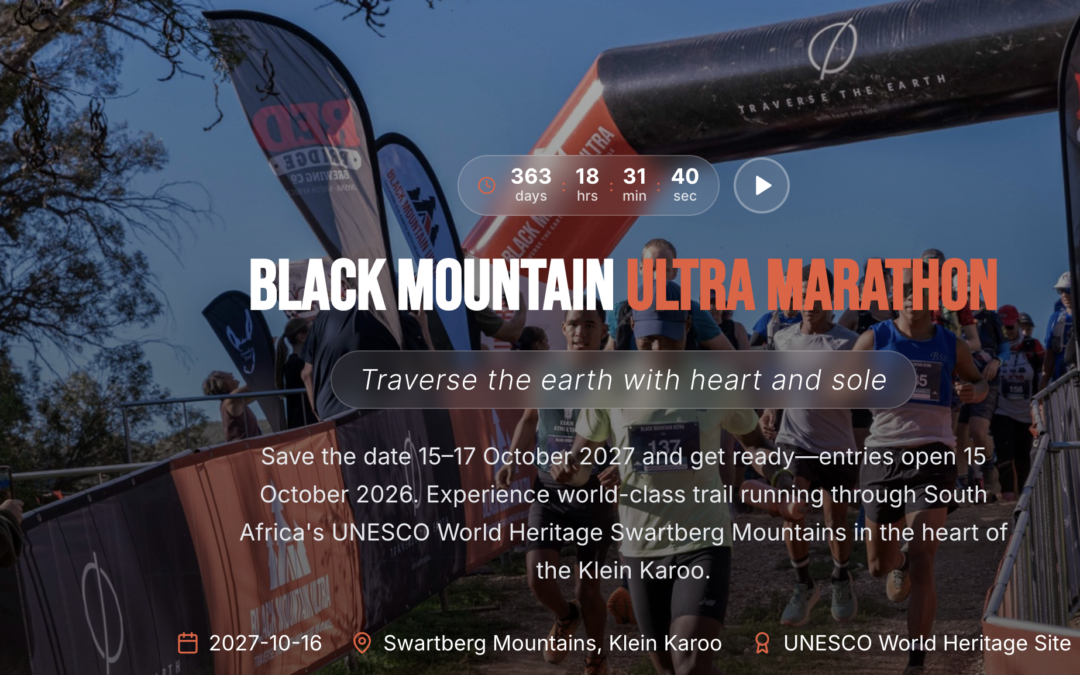
The Black Mountain Ultra returns to the Swartberg Mountains near Calitzdorp on 16 October 2027, with four trail distances through the Klein Karoo: 73 km, 43 km, 19 km and 6 km. The race village is based at The Retreat at Groenfontein, roughly four hours from Cape Town. The 73 km ultra climbs 2,838 metres and carries three ITRA points; the 43 km climbs 1,916 metres and carries two ITRA points, while the 19 km carries one. The event is listed as an ITRA-accredited and UTMB Index race.
Early-bird entries open on 15 October 2026, with 20 places available at that price per distance until 15 November, which is when the general entries are made available.
“Black Mountain Ultra is for anyone willing to prepare, respect the mountain and take on a challenge: the climb from Fonteinplaas, out of Gamkaskloof towards Donkey Camp and the route’s high point, is the race’s toughest section,” notes Elize van Staden, founder and director of Traverse The Earth and founder of Black Mountain Ultra.
“By then, runners have already descended The Ladder and crossed the valley, so the long, exposed ascent tests tired legs and mental focus. Conditions can shift from heat in the valley to cold and wind on the mountain, and reaching the top brings little respite: a long, technical descent over loose, uneven ground still lies ahead. Crossing the finish line may change what you believe you’re capable of,” adds van Staden.
The event debuted in 2026, attracting 136 participants across four routes. It is the first major experience developed by Traverse The Earth, the female-founded and female-led adventure and eco-tourism company van Staden established in 2025. Traverse The Earth is building a wider programme of cycling, trail and locally led experiences around Calitzdorp, aiming to encourage visitors to stay longer and explore more of the Klein Karoo.
For van Staden, the idea was born from the meeting of her professional experience and a deep love of endurance sport and wild places. She has completed several Ironman events and ultramarathons, including the 111 km La Ultra – The High in the Himalayas, raced at extreme altitude.
“The first seed was planted in 2010, on a five-day bikepacking trip from Prince Albert to Van Wyksdorp,” says van Staden. “We were cycling the Groenfontein Road just outside Calitzdorp, and I remember looking across this almost hidden valley with the Swartberg rising behind it. I wasn’t thinking there had to be a race here. But the place stayed with me.” The family returned to the area for years, exploring its roads, trails and mountain passes, before the idea took shape. “We wanted to share this remote landscape through an experience worthy of it,” she adds.
An event rooted in Calitzdorp
Calitzdorp brings together the Klein Karoo, the Swartberg and Gamkaskloof, as well as the relationships that made the route possible. Black Mountain Ultra may be the flagship event, but it forms part of a much bigger vision for responsible adventure tourism across Calitzdorp, Route 62 and the Klein Karoo.
Traverse The Earth is now developing cycling and e-bike experiences, connecting visitors with Calitzdorp’s wine farms, food, art, local producers and surrounding landscapes. The company is also exploring experiences in the Gamkaskloof and ways to link more of the region’s existing trails, tourism operators and natural attractions.
That ambition aligns with the Garden Route and Klein Karoo Tourism Strategy 2025–2030[1], which identifies events as a way to improve the seasonal and regional spread of tourism benefits. The strategy goes further, committing to combating seasonality through an annual events calendar with an emphasis on off-peak events. Tourism in the region peaks sharply over December and January, which places an October race squarely in the window the strategy is trying to fill. It also records the longest average tourist stay in the Western Cape here, at 3.6 days against Cape Town’s 2.8
“Route 62 is no longer being seen simply as the scenic road you take to somewhere else,” says van Staden. “More people are beginning to recognise it as a destination in its own right, where they can enjoy slower, more meaningful experiences,” she adds.
Barrydale’s recent recognition offers another example of the attention small towns in the region are receiving. The town was named South Africa’s top small town in the Daily Maverick’s Small Town of the Year Awards whilst Getaway’s coverage describes it as a place whose agricultural roots sit alongside a growing creative and food scene.
It’s an event where the entire community gets involved
The first person in Calitzdorp to say yes was Erika Calitz, who operates the Donkey Trail concession. At that point there was no event and no field of runners, but she shared her knowledge of the terrain and the community, and gave the organisers the confidence to begin conversations with CapeNature and the private landowners whose properties the route crosses. In a place where access is built on trust rather than paperwork, that early belief mattered. Local volunteers help with registration, gear checks, route marking, aid stations and runner support whilst landowners contribute local knowledge and advice on access, gates, water and the practicalities of moving people and supplies through remote terrain. Accommodation providers, restaurants, shops, farms and other businesses host and supply runners, supporters and crew.
“Runners often travel with family, friends or support crews, and many stay for several nights,” says van Staden. “We want participants to see the race as more than a start and finish line: to stay in the town, eat locally, visit the wine farms and experience more of the Klein Karoo.”
The inaugural event also put its environmental and community commitments into practical choices. Finishers received spekboom plants through Jobs for Carbon, a landscape-restoration programme in Vanwyksdorp. The organisers say 190 handmade goodie bags were made from discarded T-shirts, curtain material and other fabric waste in collaboration with Re.Bag.Re.Use and members of the Vroue Landbou Vereeniging. Single-use plastic was eliminated at aid stations, with reusable soft cups provided.
The Black Mountain Ultra also supports the Klein Karoo Athletics Fund, which helps local athletes access coaching, development and competition opportunities. Other named initiatives include Jobs for Carbon, which restores degraded spekboom veld while creating rural employment, and the Gouritz Cluster Biosphere Reserve, which works to protect biodiversity and build resilient landscapes and communities.
The mountain challenge
The 73 km route’s 2,838 metres of climbing is not one continuous ascent, but a series of climbs and descents that compound fatigue. The course passes through remote mountain terrain, including Gamkaskloof, and demands that runners manage changing conditions, nutrition and hydration. The 43 km race starts in Gamkaskloof, with organisers using a coordinated shuttle system to manage transport into the remote valley. The 19 km remains a demanding mountain race with the 6 km route as the family-friendly option.
“Black Mountain Ultra is not only for the fastest runners,” says van Staden. “It is for people willing to prepare, respect the mountain and take on something that feels bigger than their everyday experience.”
For Traverse The Earth, the race is intended to be a foundation for more than one annual event. Its longer-term ambition is to build a collection of experiences that connect visitors with the Klein Karoo’s landscapes, people and local businesses, while protecting the character of the place that drew the organisers there.
“The race is a mountain challenge, but it should end in connection: to the landscape, the people and a stronger sense of what you’re capable of. If runners leave proud, welcomed and in awe of the Swartberg and Klein Karoo, we’ve achieved our aim.”
To find out more information or book your place, visit: https://www.blackmountainultra.com.
