
Muse Code uses a local event log in which every model call, tool run, approval, and edit is appended. This single source of truth makes the runtime replay-exact and restart-safe: after a crash, the agent can resume precisely where it stopped. That ability lets Muse Code take on long-running tasks without being derailed by failures.
Muse Code ships with several default skills. /plan turns a task into an approval-gated plan, /grill stress-tests that plan until it holds up, and /goal works toward successful completion of the specified objective.
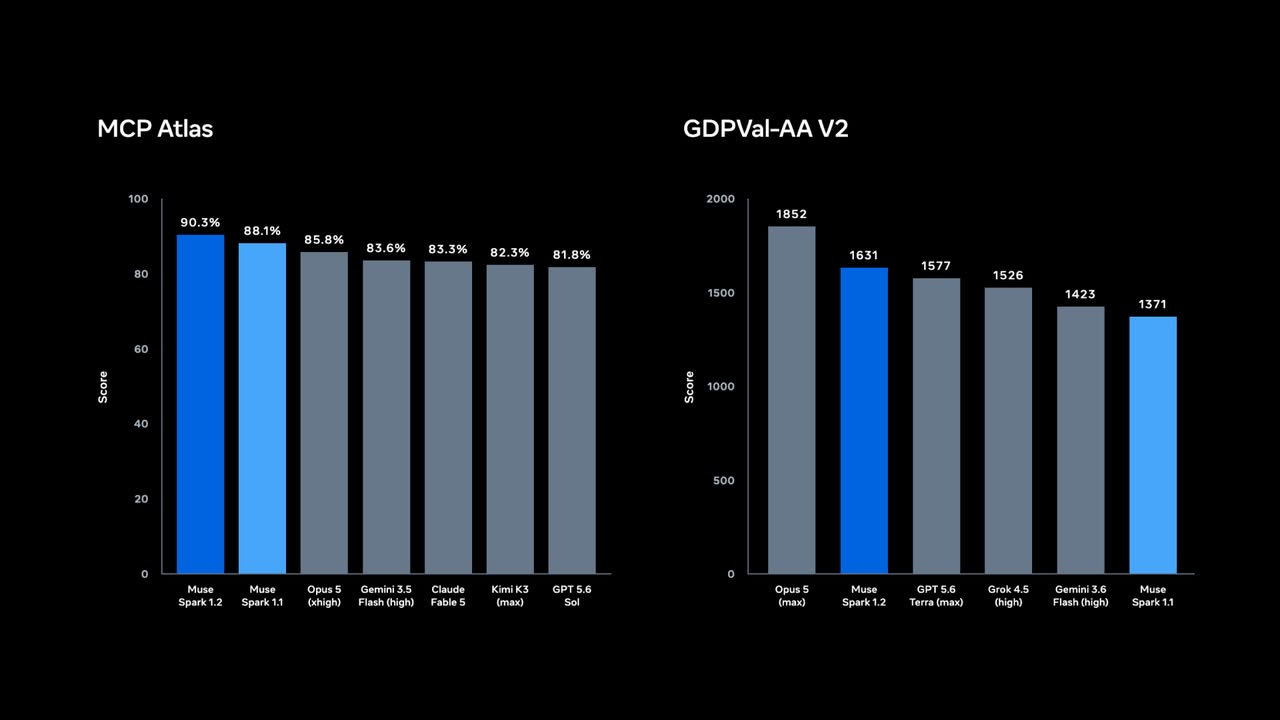
Muse Spark 1.2 is a coding-focused update to Muse Spark 1.1, with improvements in code generation, complex debugging, codebase understanding, and end-to-end developer workflows. In Muse Spark 1.2, we significantly scaled up training compute on coding tasks while expanding training environment diversity. The model also maintains its strength in other key areas like general agents.
Co-Training With Muse Code
We co-trained Muse Spark 1.2 with Muse Code to ensure the model exhibits its best performance and coding usability when paired together. The training included rejection sampled harness trajectories and recipe optimizations for goals, compaction, and subagents, alongside the integration of the Muse Code toolset to maximize harness compatibility.
Long-Horizon
Muse Spark 1.2 was extensively trained on long-horizon coding tasks, including whole-repository generation, large end-to-end projects, and auto-research. It leverages planning to sequence work, goal conditioning to maintain direction, and context compaction to retain the knowledge needed to sustain progress.
Self-Improvement
We also used Muse Spark 1.1 to generate challenging coding environments and instruction-following templates. The model then graded candidate solutions on how well they satisfied those requirements, producing a scalable training dataset for Muse Spark 1.2. This self-improvement loop helped Muse Spark 1.2 follow complex instructions more precisely than its predecessor.
Case Study: Kernel Optimization
We tested the model’s ability to iteratively optimize GPU kernels over 1,000+ tool calls (up to 24 hours). Leveraging Muse Code’s agentic coding environment, the model writes, compiles, profiles, and progressively improves kernel performance relative to a provided baseline implementation. We benchmarked on KDA and MLA kernels for NVIDIA Hopper GPUs. The agent continues to achieve substantial improvements over the provided baseline implementation.
Muse Spark 1.2 is available today in Muse Code and in Meta Model API with expanded global access. We have a lot on the horizon, including new harness features and more powerful models. We can’t wait to see what you build!
